The Art of Saying No Without Guilt
14 October 2026
There is a moment every parent knows. Your child looks up at you with wide eyes and a hopeful smile, asking for something you cannot or should not give. Maybe it is another cookie before dinner. Maybe it is a sleepover at a house you do not trust. Maybe it is a new phone because every friend already has one. The request is small on the surface, but the weight behind your answer feels enormous. You want to be kind. You want to be loved. You want to be the parent who says yes.
And yet, something in your gut whispers that yes is not the right answer tonight.
So you say no. And then the guilt arrives, quiet and heavy, like fog rolling in after a storm. You wonder if you were too harsh. You wonder if you damaged something. You wonder if your child will remember this moment as proof that you never understood them.
This is the terrain of the art of saying no without guilt. It is not a technique you master in a weekend. It is a practice, a discipline, a way of loving your child with both hands open and both feet planted. And it begins with understanding why the guilt shows up in the first place.

Why Guilt Shows Up When You Say No
Guilt is not a flaw in your character. It is a signal, and like most signals, it deserves to be read rather than silenced. When you feel guilty after telling your child no, the feeling usually points to one of several underlying beliefs.The first is the belief that a good parent is a giving parent. This belief has deep cultural roots. In many families and communities, love is measured by sacrifice, and sacrifice is measured by how much you give up. Saying no can feel like withholding love, even when the no is protecting your child from something harmful or simply holding a boundary that keeps your household running.
The second is the belief that your child's disappointment is your fault. It is not. Disappointment is a natural human emotion, and children need to experience it in safe, manageable doses. A child who never hears no grows into an adult who cannot tolerate frustration, delay gratification, or accept that other people have needs too.
The third is the belief that conflict damages the relationship. In reality, the opposite is often true. Relationships that avoid all conflict tend to become brittle. Relationships that survive honest disagreement become resilient. When you say no with warmth and clarity, you are teaching your child that love can hold difference.
The fourth is more personal. Many parents carry wounds from their own childhood, and saying no can trigger memories of being dismissed, ignored, or punished. If your no sounds like your father's no, or your mother's silence, the guilt may not belong to this moment at all. It may belong to a much older story.
Understanding where the guilt comes from does not make it disappear. But it does something more useful. It separates guilt from truth. You can feel guilty and still be right. You can feel uncomfortable and still be doing the most loving thing available to you.
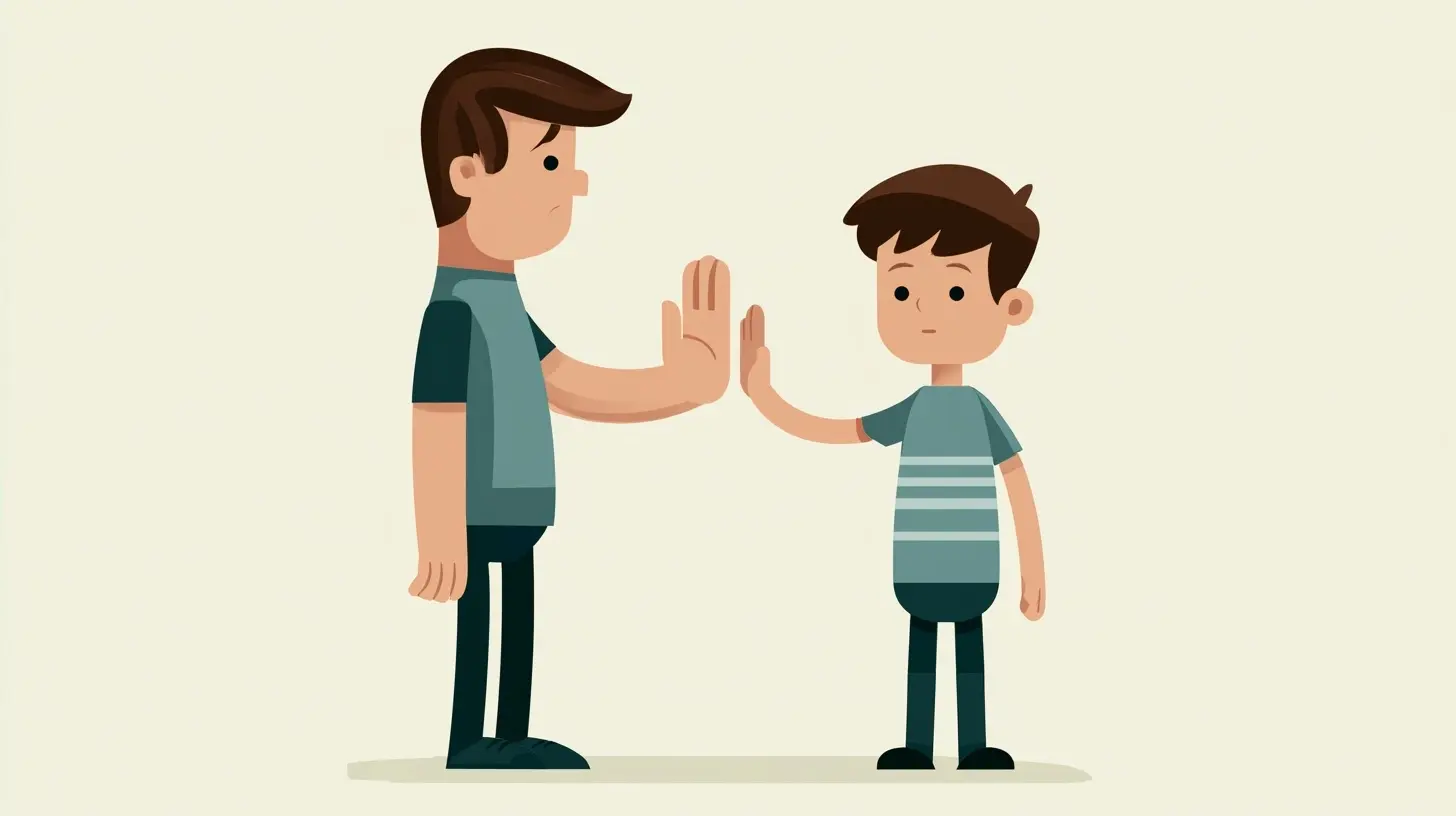
The Difference Between a Boundary and a Punishment
One of the most common mistakes parents make is confusing boundaries with punishments. They are not the same, and treating them as interchangeable creates confusion for everyone.A boundary is a statement about what you will do or allow. It is grounded in your values, your resources, and your responsibility to keep your child safe. A punishment is a consequence designed to make a child feel bad enough to change. Boundaries build trust. Punishments often erode it.
Consider a simple example. Your ten-year-old wants to stay up until midnight on a school night. A boundary sounds like this: "Bedtime is nine o'clock on school nights. That is not changing." A punishment sounds like this: "If you ask me one more time, no screens for a week."
The boundary is clear, calm, and non-negotiable. The punishment is reactive, escalating, and tied to your frustration rather than your values. Both may result in your child going to bed. Only one teaches your child that limits are stable and predictable.
When you say no from a place of boundary, the guilt tends to be lighter. You are not rejecting your child. You are holding a line that exists for good reason. When you say no from a place of punishment, the guilt tends to be heavier, because part of you knows the no was about your own need to regain control.
Before you say no, ask yourself a quiet question. Am I protecting something, or am I retaliating for something? The answer will tell you which kind of no you are about to deliver.

When No Is the Most Loving Answer
Not every no is equal. Some noes are trivial. Some are transformative. The art lies in knowing which is which.A no that protects your child's safety is almost always the right call. When your teenager wants to ride in a car with a friend who has been drinking, the no is not a negotiation. It is a lifeline. The guilt you feel in that moment is misplaced, and it is worth naming that clearly to yourself.
A no that protects your child's long-term wellbeing is usually right, even when it is unpopular. Saying no to a third hour of video games, no to skipping homework for a party, no to a relationship that is clearly unhealthy. These noes are investments. They will not earn you gratitude in the moment. They may earn you something better later, which is a child who grows up knowing that love sometimes looks like a closed door.
A no that protects your own capacity is also legitimate. Parents are not infinite. You cannot say yes to every request and remain a whole person. When you are exhausted, when you are stretched, when you have nothing left to give, a no is not selfish. It is sustainable. A depleted parent is not a generous parent. A depleted parent is a resentful one, and resentment leaks into every interaction.
There is a category of no, however, that deserves more scrutiny. This is the no that comes from fear, habit, or a need to control. Saying no because you are anxious about your child growing up. Saying no because you have always said no. Saying no because you want to feel important. These noes are not protective. They are restrictive, and they tend to produce children who either rebel loudly or comply quietly while hiding their real selves.
The art is not in saying no more often or less often. It is in saying no for the right reasons, and knowing the difference in your own heart.

How to Say No in a Way That Preserves Connection
The words matter, but the tone matters more. A no delivered with warmth lands differently than a no delivered with irritation. Here are several approaches that tend to work across ages and temperaments.The Acknowledge and Hold
This approach names the child's desire before stating the limit. "I know you really want to stay at the party longer. It looks like so much fun. And we are leaving at eight." The acknowledgment does not weaken the boundary. It strengthens it, because your child feels seen rather than dismissed.The Yes Behind the No
Sometimes you can say no to the specific request while saying yes to the underlying need. Your child wants to feel grown up, so instead of a no to the phone, you offer a yes to a later bedtime on weekends. Your child wants connection, so instead of a no to another story, you offer a yes to five more minutes of cuddling. This is not manipulation. It is translation. You are hearing the need beneath the ask.The Limited Choice
Children resist no less when they have some agency. "You can have one cookie now or two after dinner. Which do you want?" The boundary is intact, but the child gets to participate. This works especially well with toddlers and early elementary children, though it can be overused. If every no becomes a menu, your child learns that no is always negotiable.The Honest Explanation
Older children and teenagers often respond better to reasoning than to authority. "I am saying no because I do not know the parents well enough yet. I would like to meet them first." This kind of no respects your child's intelligence and models how to make decisions based on values rather than moods.The Delayed Answer
Sometimes the best no is not yet. "I need to think about it. I will let you know tonight." This gives you time to consider whether your no is grounded or reactive. It also teaches your child that good decisions take time.Each of these methods has trade-offs. The acknowledge and hold can feel repetitive if overused. The yes behind the no can slide into permissiveness if you are not careful. The limited choice can become exhausting. The honest explanation can invite debate. The delayed answer can feel like avoidance if you never actually return with an answer.
The key is flexibility. A parent who has only one way of saying no is like a carpenter with only one tool. It works for some jobs and fails at others.
Common Mistakes and Misconceptions
There are several traps that parents fall into when trying to say no without guilt. Naming them can help you avoid them.The first mistake is apologizing for the no. "I am so sorry, I really wish I could, but..." This teaches your child that your boundaries are things you feel bad about, which invites them to push harder. You can be empathetic without being apologetic. "I know this is disappointing" is different from "I am sorry I am such a terrible parent."
The second mistake is over-explaining. When you give ten reasons for a no, you are inviting your child to argue with each one. A single clear reason is usually enough. "Because I said so" is not a good reason, but "because that is our family rule" often is.
The third mistake is inconsistency. Saying no on Tuesday and yes on Thursday for the same request teaches your child that no is negotiable and that persistence pays off. Consistency does not mean rigidity. It means that your noes are rooted in something stable, not in your mood.
The fourth mistake is the guilt-driven yes. This is the yes you give because you feel bad about the no you gave yesterday. It is a trap, and it undermines the very boundary you were trying to hold. If you said no for a good reason, do not reverse it out of guilt. If you said no for a bad reason, own it and change the decision honestly.
The fifth mistake is confusing your child's anger with your failure. Your child may be furious with you. That does not mean you did something wrong. It means your child is having a feeling, and feelings are allowed. You can hold space for the anger without changing the answer.
The most persistent misconception is that saying no is a rejection of your child. It is not. It is a rejection of a request. The distinction matters, and children can learn it when we make it clear. "I love you. The answer is still no."
Cultural and Developmental Considerations
The way we say no is shaped by culture, family history, and the age of the child. In some families, a no is a single word and requires no explanation. In others, a no is an invitation to a conversation. Neither is inherently better. What matters is that the no is clear and that the child understands what is being asked of them.Developmental stage matters too. A two-year-old cannot process a long explanation. A short no, a redirection, and a hug work better. A seven-year-old can understand simple reasoning. A teenager needs to feel respected and heard, even when the answer is no. A young adult living at home needs a different conversation entirely, one that balances household boundaries with their growing autonomy.
There is also the question of temperament. Some children accept no easily. Others push back hard. Some are sensitive and need gentleness. Others are strong-willed and need firmness wrapped in warmth. Knowing your child is more useful than following a script.
What Happens When You Say No Well
When you say no with clarity and care, several things happen over time.Your child learns that your yes means something. A yes from a parent who never says no is worthless. A yes from a parent who says no when it matters is a gift.
Your child learns to tolerate disappointment. This is one of the most important skills a human being can develop. Adults who cannot tolerate disappointment struggle in relationships, work, and life. Children who learn it early are better equipped for everything that comes later.
Your child learns that love and limits can coexist. This is the foundation of secure attachment. A child who knows that their parent will hold a boundary is a child who feels safe, because they know the ground will not shift under their feet.
Your child learns to say no themselves. This is perhaps the most overlooked benefit. Children who grow up with parents who model healthy boundaries become adults who can set their own. They can say no to peer pressure, no to exploitation, no to relationships that harm them. The no you say today becomes the no they say tomorrow.
And you learn something too. You learn that guilt is not a guide. It is a feeling, and feelings are information, not instructions. You learn that you can be a loving parent and still hold a line. You learn that your child's temporary disappointment is not the end of the world, and that your relationship is strong enough to survive it.
A Final Word on Practice
The art of saying no without guilt is not about becoming hard. It is about becoming clear. It is about knowing what you value, what you can give, and what you must protect. It is about speaking your no with a steady voice and an open heart.You will not get it right every time. You will say no too quickly some days and yes too slowly on others. You will feel guilty when you should not, and confident when you should be cautious. That is not failure. That is the practice.
The goal is not a child who never hears no. The goal is a child who hears no and knows, deep in their bones, that they are still loved. That is the art. And it is worth every uncomfortable moment it takes to learn.
all images in this post were generated using AI tools
Category:
Navigating ParenthoodAuthor:

Austin Wilcox