Montessori Methods Every Parent Can Use at Home
28 August 2026
Let me guess. You saw a photo of a three-year-old carefully slicing a cucumber with a tiny knife, and your first thought was either "that is adorable" or "that is a lawsuit waiting to happen." Either way, you are now here, wondering if the Montessori method is something you can actually pull off in your living room without turning your entire existence into a Pinterest board that screams at you.
Good news. You can. Bad news. It is not about buying the right wooden toys. It is about changing how you shut your mouth and let your kid struggle for a bit. That is the part nobody puts on Instagram.
Before you throw out every plastic toy in the house and start labeling your spice rack with cursive tags, let us talk about what Montessori actually looks like in a real home, with real mess, real tantrums, and real parents who are exhausted.
The Core Idea That Nobody Explains Clearly
Maria Montessori was an Italian physician who figured out that children learn best when they are treated like actual people with their own interests, not empty vessels waiting for adults to pour facts into them. The whole method rests on one core principle: follow the child. But that phrase gets so overused and misunderstood that it might as well be a fortune cookie.Following the child does not mean letting your toddler eat glue because they are "exploring." It means observing what your child is genuinely drawn to and then providing opportunities to engage with that interest in a structured, safe, and purposeful way. It is a fine line between respectful parenting and straight-up anarchy, and most parents cross it at least once a week.
The real goal is independence. Not the kind where your kid wins a scholarship, but the kind where they can pour their own water without flooding the kitchen floor. That is the foundation. Everything else is just furniture arrangement.

The Prepared Environment: Your Home as a Tiny Kingdom
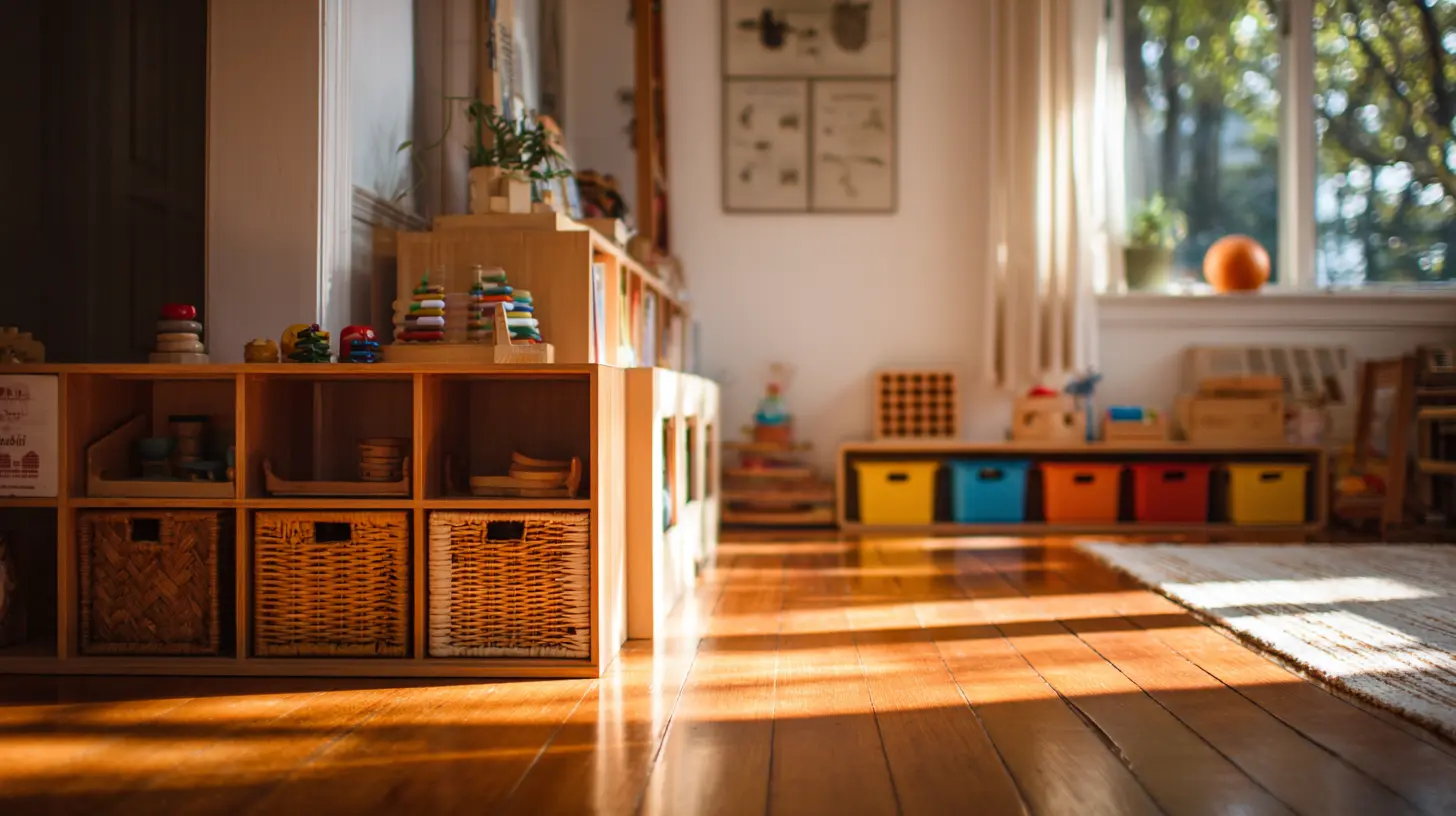
The prepared environment is the heart of Montessori. The idea is simple: set up your home so your child can actually do things without needing you for every single step. That means low shelves, small furniture, and tools that fit their hands. It also means accepting that your home will look less like a showroom and more like a preschool exploded in it.You do not need a dedicated playroom. You need to look at each room and ask one question: what can my child do here without me? In the kitchen, that might mean a low cabinet with cups and plates they can reach. In the bathroom, a step stool and a small cup for rinsing. In the living room, a low shelf with a few carefully chosen activities, not a toy bin the size of a small car.
The trade-off is obvious. Your home will look less "adult." Your minimalist coffee table will become a child-height workspace. Your nice couch will become a climbing frame. But the payoff is that your child will start doing things for themselves, and you will slowly regain the ability to drink a hot beverage.

Practical Life Skills: The Secret Sauce
Here is the part that surprises most parents. The most important Montessori activities have nothing to do with letters or numbers. They are called practical life skills, and they include things like sweeping, pouring, buttoning, and wiping up spills. Yes, you read that right. The secret to raising an independent child is letting them do chores, but framing them as meaningful work rather than punishment.Why does this work? Because young children genuinely want to imitate adults. When you let your two-year-old help you wash lettuce or sort socks, you are giving them exactly what they crave: real participation in real life. It is not busywork. It is the foundation of concentration, fine motor control, and self-esteem.
The mistake most parents make is either doing everything for their child because it is faster, or forcing their child to do tasks that are way beyond their ability and then wondering why everyone is crying. The sweet spot is finding tasks that are slightly challenging but achievable. A two-year-old can wipe a table. A three-year-old can peel a hard-boiled egg. A four-year-old can spread butter on bread. A five-year-old can help set the table.
Start small. Let them do it badly. Then let them do it again. It will take twenty times longer than doing it yourself, and that is the point.

The Myth of the Perfect Montessori Toy
Let us address the elephant in the room. The Montessori toy industry is a multi-million dollar machine that sells wooden rainbows and geometric puzzles for prices that would make a grown adult choke on their oat milk. You do not need any of it.The actual Montessori materials, like the pink tower or the golden beads, are designed for specific purposes and are often used in classrooms with trained guides. At home, you do not need to replicate that. You need to provide open-ended materials that let your child explore real concepts.
A set of measuring cups and a bowl of dried beans is worth more than any fancy toy. A basket of pinecones and shells beats a plastic activity center. Cardboard boxes are the ultimate Montessori material, and they are free.
The real secret is rotation. Do not dump fifty toys out and expect your child to focus. Put out five to eight options on a low shelf, and swap them out every week or two. This keeps novelty high without overwhelming the child. It also means you can buy fewer things and still feel like a good parent.
Practical Life for Every Age: A Brutally Honest Guide
Toddlers (Ages 1 to 3)
This age is all about gross motor skills and basic self-care. Let your toddler climb, push, pull, and carry things. Provide a small pitcher for pouring water into a cup, a basket for carrying laundry, and a low hook for hanging their coat. Expect mess. Celebrate effort, not results.The common mistake here is hovering. If your toddler is trying to put on their own shoes and it is taking forever, let them. If they are about to do something genuinely dangerous, intervene. Otherwise, back off. The frustration they feel is part of the learning process. Do not rescue them from every struggle.
Preschoolers (Ages 3 to 6)
This is where things get interesting. Your child can now handle real tools, real responsibilities, and real consequences. Let them cut fruit with a butter knife, pour their own cereal, and water the plants. They can dress themselves, brush their teeth, and pack their own bag.The trade-off is that they will make terrible decisions. They will wear stripes with polka dots. They will put too much milk in their cereal and watch it overflow. They will spill water on the floor and then walk away. Your job is not to fix it. Your job is to show them how to clean it up and then let them do it again tomorrow.
Early Elementary (Ages 6 to 9)
At this age, children can handle bigger tasks and more abstract thinking. Let them plan a meal, help with grocery shopping, manage a small allowance, and take care of a pet. They can use real tools with supervision, hammer nails, and use a stove with help.The common misconception is that Montessori ends at preschool. It does not. The principles just evolve. The prepared environment becomes the neighborhood. The practical life becomes real life. The child becomes a contributing member of the household, not just a consumer of entertainment.
Why "Let Them Figure It Out" Is Harder Than It Sounds
Here is the uncomfortable truth. The hardest part of Montessori is not setting up the environment. It is controlling your own impulses. Every fiber of your being wants to help when your child is struggling. You want to fix the puzzle piece, tie the shoe, and wipe the nose. That is normal. That is also exactly what you need to stop doing.The concept of "freedom within limits" is the key. You set the boundaries. The child operates within them. If the boundary is "we do not throw food," then you enforce that calmly and consistently. If the child is struggling to put on their jacket, you let them struggle, unless they are about to be late for something that actually matters.
The misconception is that Montessori means no discipline. That is false. Montessori means discipline that comes from within, not from external rewards or punishments. You do not bribe your child with stickers to clean up. You let them experience the natural consequence of a messy space, and you help them see that cleaning up restores order.
This is harder than it sounds. Natural consequences are slow. They require patience. And they require you to be okay with your child being uncomfortable for a little while. That is uncomfortable for you too. Welcome to parenting.
The Role of the Adult: You Are Not a Cruise Director
In a Montessori home, the adult is not the entertainer, the enforcer, or the fixer. The adult is the observer and the facilitator. You set up the environment, you model the behavior, and then you step back and watch.This is a radical shift for most parents. We are used to being the center of our children's worlds. We feel guilty if we are not actively engaging with them every waking moment. Montessori says the opposite. Your child needs time to explore independently. They need boredom. They need unstructured time where they are not being directed by an adult.
The best thing you can do is sit on the couch and read a book while your child plays. Yes, really. When you hover, you interfere. When you step back, you give your child the space to develop concentration, creativity, and self-reliance.
The trade-off is that you will feel useless. That is a feature, not a bug. The goal is to work yourself out of a job, slowly and deliberately.
Common Mistakes That Will Ruin Everything
Mistake One: Confusing Independence with Abandonment
You cannot just plop your child in a room and expect them to become self-sufficient. Independence is built gradually, with support. You need to show them how to do something, let them try, and then let them fail and try again. You are not absent. You are close by, but not in the way.Mistake Two: Buying All the Things
The Montessori market is designed to make you feel inadequate. Do not fall for it. A child can learn more from a kitchen drawer full of wooden spoons than from a $200 sensory board. The material is not the method. The method is the approach.Mistake Three: Being a Perfectionist
If you cannot handle mess, you are going to have a bad time. Montessori is messy. There will be water on the floor, flour on the counter, and paint on the table. That is the cost of doing business. If you cannot accept that, you will spend all your time cleaning up and none of your time letting your child explore.Mistake Four: Forcing It
Not every child is the same. Some children will take to Montessori activities immediately. Others will throw the wooden blocks across the room and scream for the plastic fire truck. That is okay. The method is flexible. If something is not working, change it. The goal is not to force your child into a box. The goal is to create an environment that supports their natural development.How to Start Tomorrow Morning Without Losing Your Mind
You do not need a complete overhaul. You need three small changes.First, pick one area of your home and make it accessible. A low cabinet in the kitchen with cups, plates, and a small pitcher of water. That is it. Let your child get their own drink. Deal with the spills.
Second, pick one practical life activity and let your child do it with you. Washing vegetables, folding napkins, or matching socks. Do it slowly, and let them take over. Do not correct them. Let them be bad at it for a week.
Third, create a "yes" space. This is an area where your child can do anything without being told no. It might be a corner of the living room with a mat and a few activities. It might be a whole room if you have the space. The point is that your child has a place where they are in charge, and you are not hovering.
Start there. Do not try to do everything at once. The Montessori method is a marathon, not a sprint. You will make mistakes. You will lose your patience. You will yell at your child for spilling water for the fifth time in one hour. That is normal. Apologize, clean it up, and try again tomorrow.
The Political and Social Reality of Montessori at Home
Let us be honest about one thing. Montessori is not neutral. It comes with values, and those values are often at odds with the broader culture. We live in a world that wants children to be compliant, quiet, and easily entertained. Montessori wants children to be independent, curious, and occasionally inconvenient.This will create friction. Your mother-in-law will question why your three-year-old is using a real glass instead of a sippy cup. Your friend will think you are being lazy when you let your child struggle with their shoes. Your child will throw a fit at the grocery store because you will not let them push the cart into the shelves.
That is fine. You do not need to defend your choices to anyone. You are raising a human being, not a show pony. The goal is not to have the most well-behaved child in the room. The goal is to have a child who can think for themselves, who is not afraid of failure, and who knows how to take care of themselves and others.
That is a long game. And it is worth it.
When Montessori Does Not Work
Sometimes it does not. Some children have special needs that require a different approach. Some children are so strong-willed that freedom within limits becomes a daily battle. Some parents are so overwhelmed that the thought of adding "prepared environment" to their to-do list makes them want to cry.That is okay. Montessori is not a religion. It is a set of principles that you can adapt to your life. If it is causing more stress than it is solving, change it. Take what works and leave the rest. The goal is a happy, functional family, not a perfect Montessori aesthetic.
The best Montessori parents are not the ones who have the most beautiful shelves or the most expensive materials. They are the ones who understand that their child is a person, not a project. They respect that person, and they show that respect through their actions, not their words.
The Final Word: You Are Already Doing Better Than You Think
You are reading this because you care. That puts you ahead of the curve. The fact that you are willing to question your parenting, to try something new, and to invest time in understanding how your child thinks means you are already a good parent.So stop worrying about getting it perfect. Start with one small change. Let your child pour their own milk. Let them struggle with their zipper. Let them be bored for ten minutes without you offering a screen. Watch what happens.
You might be surprised. Your child might surprise you. And you might surprise yourself.
The Montessori method is not about creating perfect children. It is about creating an environment where children can become themselves. That is the best gift you can give them, and the best gift you can give yourself is the chance to watch it happen.
all images in this post were generated using AI tools
Category:
Early Childhood EducationAuthor:

Austin Wilcox
Discussion
rate this article
1 comments
Daniel McTavish
Embracing Montessori at home isn't just for educators. It empowers kids to explore and learn independently. Simple adjustments can ignite their curiosity and confidence-so let's get started today!
August 30, 2026 at 4:15 AM
Austin Wilcox
Absolutely! Small changes can make a big difference in fostering independence and curiosity in kids. Let's inspire our little learners!